
Automatic Main Valve Shutoff for Insurance
For us, this didn’t start as a business idea. It started as a requirement.
That experience is becoming increasingly common across California. Insurance companies are under pressure to reduce water damage claims, which are now the most frequent and costly type of homeowners claim. As a result, insurers are no longer relying on premium discounts alone. They are actively pushing homeowners to install automated protection systems that can shut off water before damage spreads.
That moment is what started everything for us.
Why Insurance Companies Are Requiring Automatic Shutoff Systems
Water damage has changed. It is no longer a minor claim or an inconvenience. With today’s policies, many California homeowners face 1 percent dwelling deductibles, meaning a single water loss can easily cost $5,000, $8,000, or more out of pocket before insurance even applies.
Insurance carriers are reacting the only way they can: by trying to stop claims before they happen.
Automatic main valve shutoff systems do exactly that. When a leak is detected, the system shuts off the home’s main water supply automatically, limiting damage to minutes instead of hours. From an insurance standpoint, this is one of the most effective ways to reduce claim severity and frequency.
That is why many carriers are now making these systems a condition of coverage, not just a nice-to-have add-on.
The Insurance Referral Model And Its Limitations
In many cases, insurance companies refer homeowners to specific products, most commonly the Moen Flo system. While this solution works for some homes, it also comes with tradeoffs that homeowners should understand before installing it simply to satisfy an insurance requirement.
Moen Flo relies heavily on usage pattern learning to detect leaks. The system monitors water flow over time and attempts to determine what is normal for a household. When it sees something outside that learned pattern, it may trigger a shutoff.
That approach has a few downsides:
- Any change in routine, guests, irrigation use, or plumbing behavior can cause false shutoffs
- Ongoing monitoring is required
- The system depends on continuous power
- Detection is indirect rather than point specific
In addition, Moen installs are typically handled through third party plumbers. While that allows for scale, it also separates the product manufacturer from the installation itself. In practical terms, responsibility for installation quality, system placement, and long term performance can become fragmented.
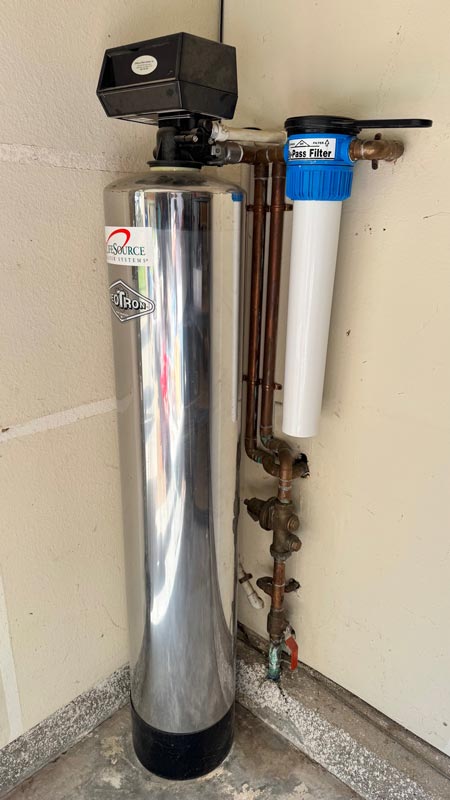
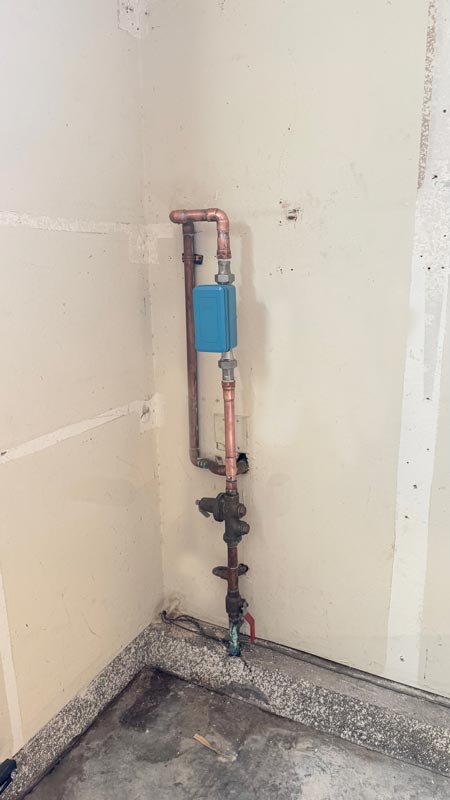
Quick Project Details : Remove the old water filter (no longer working), install the NEW Automated Main Water Shutoff System. Includes : Hub with cellular backup access, 10 AP (remote water detection pucks). Protects: All Sinks, All Toilers, Dishwasher and Washing Machine.
A Different Approach: Physical Detection And Direct Automation
Our approach is fundamentally different.
Instead of relying on learned usage patterns, our systems use physical detection and direct automation. When a real trigger occurs, the main water supply is shut off automatically, typically in about 20 seconds. There is no learning period, no guesswork, and no dependency on behavior modeling.
This matters for reliability.
Our automated shutoff valves are:
- Battery operated
- Monitored for battery health
- Designed for long term use, with up to a 10 year operating lifespan
- Not dependent on continuous household power
Most importantly, the shutoff is 100 percent real and automatic. When a trigger is sent, the valve closes. There is no delay waiting for pattern analysis, no notification that requires homeowner action, and no uncertainty about whether the system will respond correctly.
This makes the system predictable, fast, and insurance friendly.
Installation Matters More Than Most Homeowners Realize
Another major difference is how installation is handled.
We are both the system provider and the installer. That means we are responsible for:
- System selection
- Valve placement
- Plumbing compatibility
- Testing and validation
- Long term support
There is no handoff between manufacturer and installer, and no ambiguity about who owns the outcome. We work with proven device manufacturers, but we stand behind the full system as a whole.
In the example shown here, an outdated and non functional water filtration unit was removed as part of the install process. This kind of cleanup is common in older homes and helps ensure the shutoff system is installed cleanly, safely, and without unnecessary restrictions or failure points.
Real Automation, Not Alerts
The video included with this post shows exactly what happens when a trigger is sent. There is no simulation, no demo mode, and no learning algorithm involved. The water shuts off automatically and immediately.
This is what insurance carriers are ultimately looking for: fast, reliable, automatic response.
Not alerts.
Not notifications.
Not someone should check this.
Action.
Looking Ahead: Monitoring And Ongoing Protection
We currently focus on robust detection and automated shutoff. Ongoing monitoring services are planned for release in June 2026, adding another layer of visibility and long term protection for homeowners who want it.
The goal remains the same: reduce risk, prevent claims, and give homeowners a reliable way to meet insurance requirements without unnecessary complexity or subscription dependency.
Bottom Line
Automatic main valve shutoff systems are no longer a future concept. In California, they are quickly becoming a present day requirement.
Homeowners now have a choice: install the minimum system required to check a box, or install a system designed to act fast, shut off water reliably, and actually prevent damage.
We built our approach based on real insurance requirements, real homes, and real plumbing conditions. Because that is what this problem demands.